

1920–1923::Farson and the Cowichan Lake Float Houses
- Papertown Station

- Aug 9, 2020
- 6 min read
Updated: May 12
An early 20th-century journalist and adventurer who made a float house on Vancouver Island his home.

"1915::James Scott Negley Farson: Journalist, Aviator, Civil Engineer, Adventurer (1890–1960)"
Photograph: Passport application (1915)
Long before James Bond, there was a man who could make women swoon and who did the kinds of things most men of his time only dreamed of. That man was Negley Farson. A partially educated American journalist and civil engineer, he wandered the earth in pursuit of extreme adventure—trading arms in revolutionary Russia, interviewing Gandhi shortly before his arrest, and crossing Europe by sailboat while reporting on a continent still recovering from the war. Yet for all his worldly adventures, Vancouver Island, and a float house on Cowichan Lake, was his favourite place to call home.
“Almost everything happened to him that befalls a living man.” — Kenneth Scott, Newcastle Morning Herald and Miners’ Advocate (1936)

“1920::Uncle Dick’s Cabin on the North End of Cowichan Lake, Vancouver Island”
Magazine clipping: Britannia and Eve (1935)
London, England — Illustrated London News Group / British Library
At the outbreak of the First World War, Farson joined Britain’s Royal Flying Corps and was sent to Egypt, where his plane was shot down in action. He was sent back to Britain to recover from a severe leg injury and fell in love with his nurse, Eve Stoker, niece of Bram Stoker of Dracula fame. When the doctors could do no more for Farson’s leg, they prescribed sunshine and rest as the next step in his recovery. Eve knew just the place: Uncle Dick’s cabin.

"1920::Negley and Eve's Dual Passport"
Photograph: Dual Passport application (1920)
Penniless after the war, Negley and Eve married and soon arrived on Vancouver Island, where they were challenged to live on just £10 a month. They met up with Eve’s uncle, Dr. Richard “Dick” Stoker—Bram Stoker’s brother—who had retired to the Cowichan Valley in 1898. Uncle Dick gave the newlyweds the keys to his summer cabin, where they would spend the first of nearly three years at Cowichan Lake.

"1921::The Farsons’ Cowichan Lake Float House"
Magazine clipping: Britannia and Eve (1938) London, England — Illustrated London News Group / British Library
During their first full summer on the island, the Farsons joined their neighbours on Cowichan Lake, leaving Uncle Dick’s cabin for a float house. Each day, they lifted their moorings and drifted to a new view of the lake. Life was good, and Negley got his sunshine as prescribed.
"It was merely a raw board shack built on a cedar raft, but it had this advantage - we could pull up its wooden pile moorings and let it drift just to see where we would wake up in the morning." — Negley Farson, The Illustrated Sporting and Dramatic News (1934)
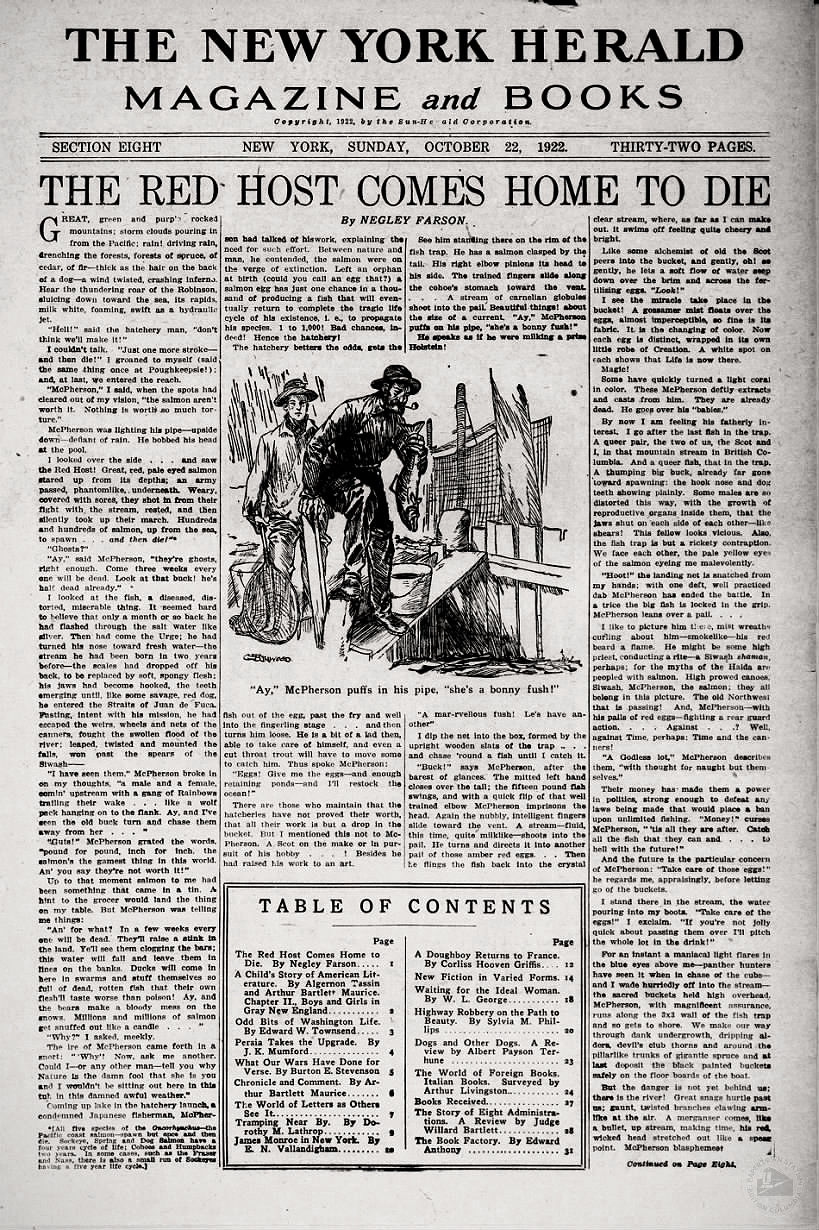
“1922::Farson’s Breakthrough Fiction Story — Inspired by Vancouver Island”
Newspaper clipping: The New York Herald (1922)
New York, New York
Farson believed that while his leg healed, he could make a living writing short fiction from his float house on Cowichan Lake. Breaking into the industry proved harder than expected though, and the young couple struggled to make ends meet. With an empty larder and a stack of rejection letters on his desk, he wrote to an old friend at The New York Herald, who suggested he turn his attention to what life was like on Vancouver Island. Taking the advice, he spent the summer writing and observing the world around him. When he next heard from his friend, it was with a roll of dollar bills and a copy of The New York Herald, carrying his first major short story on the front page of its “Magazine and Books” section—a story inspired by the life around him on Vancouver Island.

"1921::Eve Stoker Cooking Trout Near Shaw Creek, Vancouver Island"
Magazine clipping: Britannia and Eve (1935)
London, England — Illustrated London News Group / British Library
By 1923, nearly two years on Cowichan Lake had brought healing, a measure of success, and the first real signs of recognition for Farson as a writer. Neither wanted to leave, but they were not ready to settle. At the dawn of their third summer on the lake, the Farsons left Vancouver Island in search of a new direction—one that would soon capture the attention of readers around the world.

"1925::Map of the Farsons' Journey Through Europe on a Small Yawl"
Map: Sailing Across Europe (1926), by Negley Farson
In many ways, the journey that lay ahead was not entirely unfamiliar to them. On Cowichan Lake, the Farsons had grown used to navigating narrow channels and winding rivers in search of supplies and contact with the outside world. In 1925, they set out on a 3,000-mile sail across Europe in a 26-foot yawl named Flame. With Negley as captain and Eve as his crew, they descended some of Europe’s most obscure and least-used waterways, routes few seafarers had attempted. Farson wrote daily accounts of their journey for the Chicago Daily News, capturing the scenery, the people, and the challenges of life along the waterways. For three weeks, his reports captivated readers around the world as the Farsons travelled the little-known—and now largely abandoned—Ludwig Canal, linking the Rhine to the Danube.

“1926::One of the 101 Locks on the Ludwig Canal”
Book photograph: Sailing Across Europe (1926), by Negley Farson
Here, the scale of their journey became clear. The Ludwig Canal stretched over 107 miles and passed through more than 100 locks, making it longer than either the Suez or Panama canals. By the time the Farsons arrived, the canal had fallen into disuse. Its locks were deteriorating, and its waters lay quiet. Yet it remained Europe’s only freshwater link between the North and Black Seas. Since 1905, only two boats had successfully navigated its full length. The Farsons’ yawl, Flame, was officially the third vessel to make it through. At the end of their journey, despite the excitement and fame it brought them, Farson later admitted there was no place in the world where he wrote as well as he did during his summers on Cowichan Lake.

"1921::Negley Farson Collecting Driftwood on Cowichan Lake, Vancouver Island"
Magazine clipping: Britannia and Eve (1938)
London, England — Illustrated London News Group / British Library
Farson continued to seek out new adventures, with Eve keeping pace at every turn. During the Second World War, he worked as a war correspondent for the Chicago Daily News, but lost his position after his editor felt his writing carried too strong a British perspective. He continued to write regardless, and with an uncanny instinct for being where the story unfolded, his work soon began to appear regularly in major newspapers—including the very paper that had dismissed him.
“Twice a week I rowed five miles down to the store to get mail and groceries. I always trolled on the way down—or took a shot-gun. When the seasons overlapped I took both.” — Negley Farson, The Illustrated Sporting and Dramatic News (1934)

"1921::The Farsons Camping Lakeside at Cowichan Lake, Vancouver Island"
Magazine clipping: Britannia and Eve (1938)
London, England — Illustrated London News Group / British Library
Success came more easily to Farson after he left Vancouver Island, but over the years, alcohol became a problem. He wrote candidly about his vice in some of his work and eventually became known as the man who could not only out-drink Ernest Hemingway, but out-Hemingway him as well. Hemingway—and perhaps Fitzgerald—would have agreed.
“…water so clear that you sometimes think your skiff must be floating in air, and, of course, the feeling of being there when the world was freshly made, as you always do feel in the remote regions of British Columbia.” — Negley Farson, Going Fishing (1942)

"1935::A Reflection of Negley Farson’s early years at Cowichan Lake"
Newspaper clipping: Victoria Daily Times (1935), excerpt arranged for readability
Victoria, British Columbia
Although the people of the Cowichan Valley did not realize it at the time, a star had been born on Cowichan Lake. Farson spent most of his time writing as his house drifted on the lake, occasionally travelling to Duncan to send off his work to publishers in Chicago, Boston, or New York. Within a few short years, Vancouver Island had helped shape one of the most prolific journalists of his time.
“Yes, we lived on an island lake in British Columbia for two years, subsisting largely on a shot-gun, fishing-rods and an overworked typewriter—and I wouldn’t swap them for any other two years of my life. Not by a long shot!” — Negley Farson, Britannia and Eve (1938)
Story Timeframe: c. 1920–1923
Sources are credited where known. Historical materials are reproduced for research, commentary, and education, with digitized materials sourced from archival collections including Newspapers.com, the British Newspaper Archive, the British Colonist (University of Victoria) and other digital repositories, including wire service images such as the Associated Press, credited where known. Images have been cropped and enhanced for clarity where necessary.


