

1966::The Three Towers of Victoria, British Columbia

Updated: May 12
Three proposed towers Victoria never built.
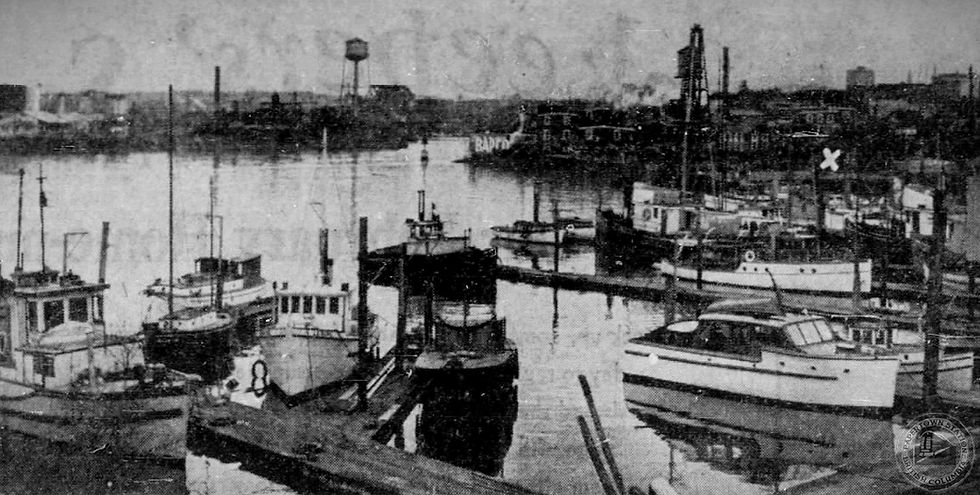
"1946::View from Fisherman’s Wharf toward Songhees and Laurel Point"
Newspaper clipping: Victoria Daily Times (1946)
Victoria, British Columbia
In 1946, a pioneer Vancouver Island fishing family purchased a waterfront lot adjacent to Laurel Point in Victoria’s Inner Harbour (marked “X” in the photo above). There, they constructed a two-storey warehouse and launched a business selling and shipping high-quality fish. One year later, a fire ravaged the surrounding neighbourhood, forcing the business to shut down for good. The family never returned.
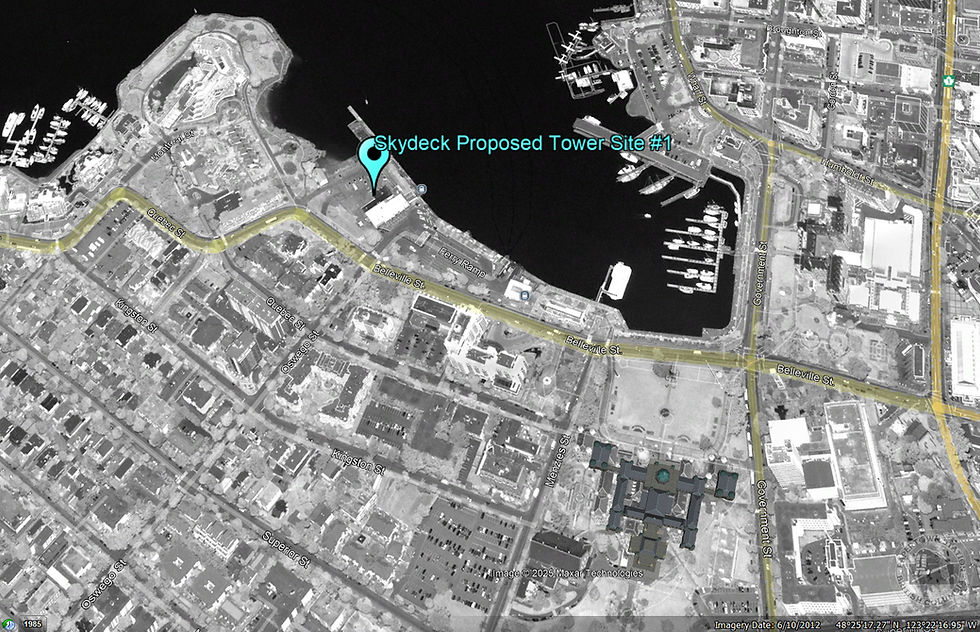
"1966::The Site of the First Proposed Skydeck Tower on Belleville Street in Victoria's Inner Harbour"
Screenshot: Google Earth (Maxar Technologies) (2012)
Twenty years later, in 1966, with Canada’s centennial fast approaching, Victoria’s city council sought to revive activity in the Inner Harbour. Passenger traffic had declined as newer ferries began carrying tourists to larger ports elsewhere, and the city was under pressure to draw them back. As the provincial capital, Victoria was expected to play a leading role in the nationwide celebrations.
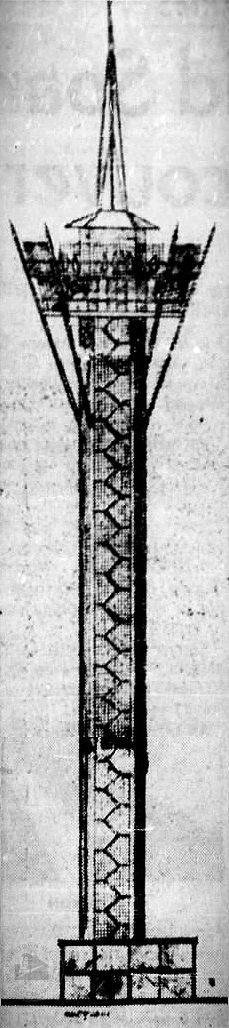
"1966::An All-Aluminum Skydeck Tower For Victoria's Inner Harbour"
Newspaper clipping: Victoria Daily Times (1966)
Victoria, British Columbia
In early March, a company called Skydeck approached Victoria’s city council with a proposal to build the world’s first all-aluminium observation tower in the Inner Harbour. Rising 300 feet from its proposed site on Belleville Street, it would stand more than twice the height of the Parliament Buildings. At its base, a marine pond with seals and other sea life would greet visitors. Inside, an enclosed elevator would carry them upward to two circular decks at the top of the structure. The lower level would include a café and souvenir shop, while the upper open-air deck would offer sweeping views of the city and surrounding islands, with Mount Baker and Mount Rainier in the distance, and views across the Strait of Juan de Fuca to the Olympic Mountains.
"The tower would create a lot of free advertising for the city. Think of the photos the tourists would take from the top of the tower and later show their friends." — Skydeck spokesman (1966)

"1966::A Proposed Skydeck Tower On the Grounds of Craigdarroch Castle"
Photograph: BC Archives (I-67641)
Skydeck proponents argued that the tower would boost local tourism, comparing it to the success of the Eiffel Tower in Paris and the newly built Space Needle in Seattle. While the city continued to consider the proposal, a local resident put forward an alternative idea. He believed the success of any observation tower would depend on its location and suggested it be built beside Craigdarroch Castle. Many Victorians dismissed the idea as hair-brained, outrageous, tasteless, and absurd. Nonetheless, it received some consideration when the School Board, a long-term tenant of the castle, announced it would vacate the premises by the end of the year, leaving the building empty. Ultimately, the proposal was rejected by an overwhelming majority and was heard of no more.
"First we restore the castle to its 19th century splendor, then attach a symbol of the 21st century to it." — Victoria resident, neighbour of Craigdarroch Castle (1966)

"1966::A New Kind of Tower and a New Proposal for Victoria's Inner Harbour"
Newspaper clipping: Victoria Daily Times (1966)
Victoria, British Columbia
The city council struggled to settle on a clear plan for the Inner Harbour and began taking Skydeck’s proposal more seriously. Members agreed the tower should not be made of aluminium and should not occupy Belleville Street’s prime waterfront property. As Skydeck worked to revise its design, a second proposal emerged from local businessman Charlie White. White had recently opened his Undersea Gardens in Oak Bay and was looking to expand. He proposed increasing passenger ferry service and building a new unloading dock closer to Laurel Point, replacing the ageing buildings along Belleville Street with parking for the new ferries. He would also reshape the Inner Harbour with an “Olde England” character. On the existing pier, he would build a 90-room Tudor-style hotel with a restaurant, shops, and views of the Johnson Street Bridge. Beside the old Canadian Pacific Railway terminal, he would build a 100-foot clock tower, to be called Parliament Tower. There, visitors could enjoy a drink while looking out through the glass clock face. The proposal, estimated at 2.5 million dollars, quickly received informal support from the mayor and council.

"1966::Skydeck's Second Proposal and White's Tower Proposal On Victoria's Harbour"
Screenshot: Google Earth (Maxar Technologies) (2012)
With White’s proposal under consideration, Skydeck returned with a revised plan for a 325-foot steel and glass tower, which they believed would improve the appearance of the waterfront. However, critics argued that a space needle of any design would spoil the character of the Inner Harbour and make it resemble a fairground.

"1966::Skydeck's Second Proposed Tower On Montreal Street"
Newspaper clipping: Victoria Daily Times (1966)
Victoria, British Columbia
Observation towers had become a popular feature in major cities, following the success of the Eiffel Tower in France, the Stuttgart Tower in Germany, and the newly built Space Needle in Seattle. Even so, the concept did not align with Victoria’s character. The city council nevertheless responded favourably to Skydeck’s revised design and again gave it serious consideration. But Skydeck surprised observers when it abruptly withdrew its proposal, sensing it would be rejected.
"This tower would give tourists something to do when they come here." — Skydeck spokesman, 1966

"1966::Three Proposed Lots for Three Different Plans"
Newspaper clipping: Victoria Daily Times (1959), modified with added towers
Victoria, British Columbia
In response to council concerns, Skydeck began looking for an alternative to the Belleville Street site and identified a location on Montreal Street next to Laurel Point. It was the former site of the fish operation abandoned in 1948 and now occupied by the Net Loft Seafood Restaurant. Skydeck and the restaurant’s owners quietly worked together on a new plan. The tower would be built on the restaurant’s site, and the restaurant would move into the structure as part of the attraction.

"1966::Victoria's New Skydeck Tower on Montreal Street"
Newspaper clipping: Vancouver Sun (1966)
Vancouver, British Columbia
With a new location and Victoria’s best seafood restaurant incorporated into the plan, Skydeck moved forward with renewed confidence. The tower’s height was increased to 350 feet, and although council approval was not required under the property’s light industrial zoning at the time, they sought it anyway. On June 24, 1966, Victoria’s city council approved the revised proposal, valued at 5.5 million dollars. Skydeck began preparations soon after, aiming to complete the tower by the following spring. With plans in place, Victoria appeared set to gain a new observation tower and a revitalised harbour. Within weeks, however, a tragic event elsewhere would change the course of the project.

"1966::Tragedy and the Disappearing Towers"
Newspaper clipping: The Austin American (1966), American-Statesman/UPI
Austin, Texas
Just weeks after Skydeck received council approval to proceed, Victoria’s proposed tower projects came to a halt. Headlines were soon dominated by news from the University of Texas, where a gunman opened fire from the campus tower. From an observation deck, he shot at people below for 96 minutes before being stopped by police. When it ended, 15 were dead and 31 injured. The bodies of the gunman’s wife and mother were found later that day, bringing the total number of victims to 17, making it the deadliest mass shooting by a lone gunman in U.S. history at the time. When news of the shooting reached Victoria, momentum behind the tower proposals quickly faded. Work on White’s harbour tower and Skydeck’s Laurel Point project stopped, and no formal explanation was given. In the months that followed, further losses deepened the silence. Skydeck’s spokesman died while fishing on the Cowichan River, and Victoria’s mayor died at home less than a year into his first term. By the end of the year, the city’s tower proposals had quietly disappeared.
Story Timeframe: c. 1966
Sources are credited where known. Historical materials are reproduced for research, commentary, and education, with digitized materials sourced from archival collections including Newspapers.com, the British Newspaper Archive, the British Colonist (University of Victoria) and other digital repositories, including wire service images such as the Associated Press, credited where known. Images have been cropped and enhanced for clarity where necessary.


